A bent rim rarely looks bent. Most of the damage is on the inner lip where you cannot see it without pulling the wheel, so the first thing you notice is usually a vibration — and vibrations have several causes. Here is how to tell them apart before you pay anyone.
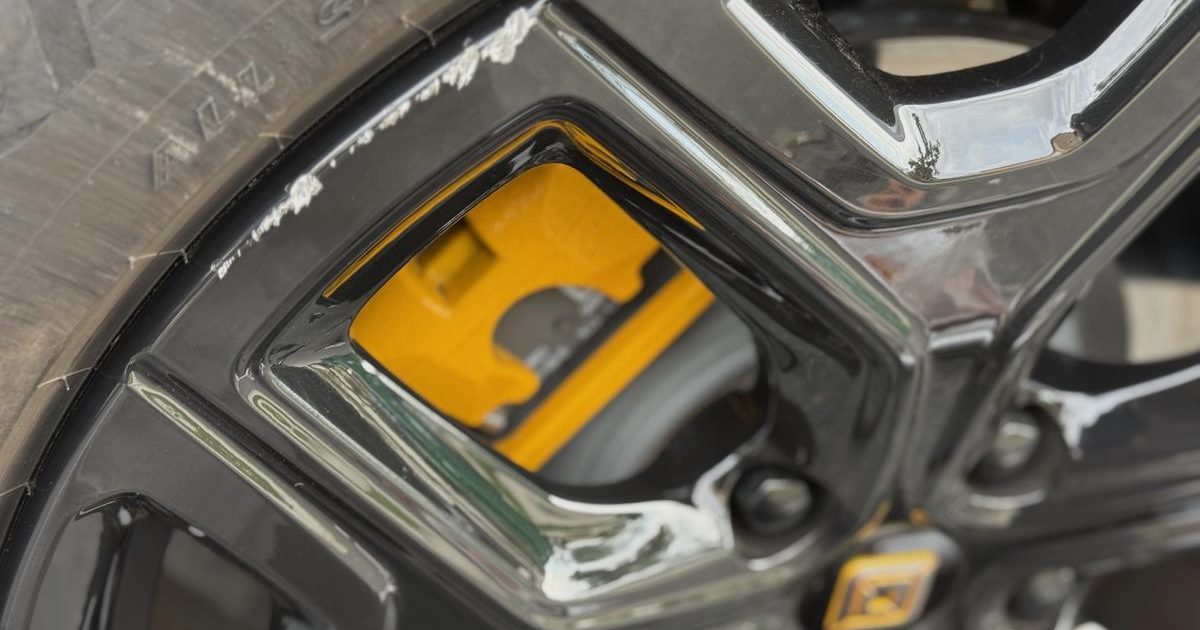
The signs, in the order people notice them
1. Vibration that scales with speed
The classic one. It typically appears somewhere around 45-55 mph and gets worse the faster you go. A bent wheel spins out of true once per revolution, so the shake tracks road speed rather than engine speed. If you can rev the engine at a standstill with no vibration, but it appears at 50 mph, that points at a wheel or tyre, not the drivetrain.
2. Where you feel it
Through the steering wheel usually means a front wheel. Through the seat or floor usually means a rear. It is a rough guide, not a diagnosis, but it tells the shop where to look first.
3. A tyre that will not stay balanced
This one is the giveaway. The tyre gets balanced, feels fine for a few days, then goes off again — or the balancer needs an unusually large weight. A balancer corrects mass distribution; it cannot correct a wheel that is not round. If a shop has balanced the same wheel twice, ask them to check runout.
4. Slow air loss with no puncture
A distorted bead seat lets air past the tyre bead. If one wheel drops a few PSI a week and no puncture can be found, suspect the rim rather than the tyre.
5. A visible flat spot — if you look in the right place
Most bends are on the inner lip, facing the suspension. Turn the steering to full lock and look at the back edge of the front wheels; that is the one place you can see inner damage without removing anything.
What it is not
Not every vibration is a bent rim. Before assuming:
- Tyre wear or a separated belt produces a similar shake. A belt separation often gives a visible bulge in the sidewall.
- Brake judder appears under braking and not otherwise — that is a disc problem, not a wheel one.
- Worn suspension or a failing bearing tends to add noise that changes when cornering.
A shop that measures rather than guesses will put the wheel on a stand and read runout before quoting anything. Ours does — see wheel straightening for what the repair itself involves.
Why it is worth fixing promptly
A bent wheel is not only uncomfortable. It loads the tyre unevenly and wears it in patches, it puts cyclic stress through wheel bearings and suspension bushes, and a distorted bead seat can leak. Straightening the wheel often saves the tyre as well, which changes the cost comparison considerably.
When a wheel should be replaced instead
Two situations, and we will tell you plainly if either applies:
- A crack in a structural area — inner barrel, spokes, around the bolt holes. We do not weld those and return them to the road.
- Alloy that has already begun to fatigue from a severe bend, where working it further risks a failure later.
We would rather lose the job than hand back a wheel we would not run ourselves.
Getting it checked
Kerb strikes hard enough to bend a rim usually damaged the finish too, so a bent wheel and curb rash often arrive together. Text a photo to (949) 800-8502 and describe the vibration — where you feel it and at what speed — and we will tell you what to expect before you drive over.
Common questions
What does a bent rim feel like when driving?
A vibration that gets worse with speed, usually appearing around 45-55 mph. Felt through the steering wheel it is typically a front wheel; through the seat or floor, a rear. It tracks road speed rather than engine speed.
Can a bent rim be repaired or does it need replacing?
Most bends are straightenable on a hydraulic press and re-measured to confirm they are true. Replacement is only necessary when the wheel is also cracked in a structural area, or when the alloy has fatigued from a severe bend.
Is it safe to drive on a bent rim?
Short distances at low speed, generally. But a bend can leak air, wear the tyre unevenly and stress bearings and suspension — and from the driver's seat you cannot tell whether there is also a crack. Get it inspected.
How can I tell a bent rim from a tyre problem?
A tyre that will not stay balanced, or that needs an unusually large weight, points at the wheel. Brake judder that appears only under braking is a disc problem. A visible sidewall bulge suggests a separated belt rather than a bent rim.
Will straightening fix my vibration?
If the bend is the cause, yes. If it persists after straightening and rebalancing, the cause is elsewhere — tyre, hub or suspension — and we will say so rather than sell you more wheel work.
Text us a photo of the wheel
We quote from photos every day. Straight-on, in daylight, and you will have a real number back — no trip required.
Get a price for your wheels
Tell us what happened to the wheel. We reply with a real number, not a "starting from".
Request received.
We will come back to you shortly. For anything urgent, call (949) 800-8502.Prefer to text a photo? (949) 800-8502